
Battle and Executions
Books XXII of the Odyssey

The fight is on! And at the beginning, it looks like all 108 suitors against Odysseus alone.
Odysseus jumps from his son’s side to the door sill. Rags off! Is he literally fighting naked, as if an athlete at the games?
He pours the arrows on the ground. How many? When he runs out of arrows, they’ll still have two score suitors to deal with, which means before then they’ll have to have killed over 60. And it turns out, according to my sources, that he could have dumped out 60 arrows out of that quiver.
The Book and Sword blog, quotes page 68 of Ellis H. Minns, Scythians and Greeks: A Survey of Ancient History and Archaeology on the North Coast of the Euxine from the Danube to the Caucasus (Cambridge University Press: Cambridge, 1913) which claims to have found 200 to 300 arrows in quivers from Scythian graves .
The Book and Sword blog article goes on to state:
“Soldiers in Babylonia in the same period usually carried 30 to 60 arrows, the Strategikon recommends that Roman soldiers carry 30 or 40 in a quiver, and English archers in the 14th, 15th, and 16th century usually carried a sheaf of two dozen arrows.”
There were 108 suitors, so I tried to imagine the size of the main hall, the megaron, where all the feasting and fighting takes place. I found an archaeology article about the throne room, which would have been in the megaron, of Nestor’s Throne Room, dated to 1300-1200 BC, located in Pylos, Greece. Assuming Odysseus’ palace in Ithaka was similar, it might have looked something like this:
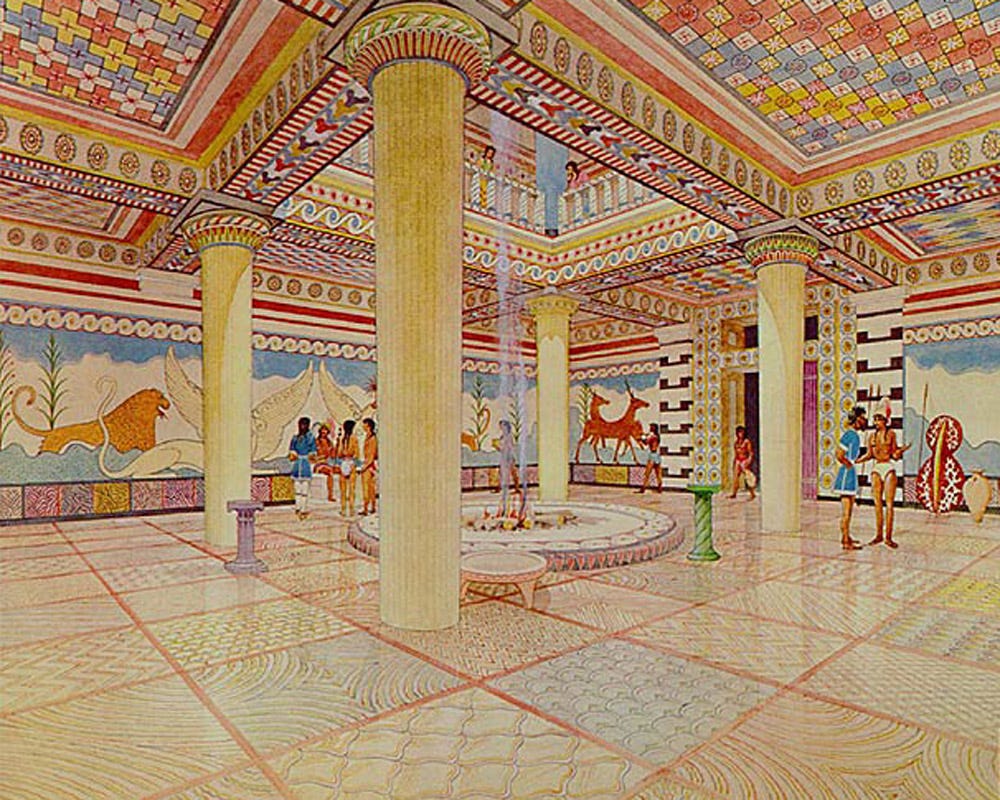
Now Odysseus says he’ll try to hit a target that no man’s hit before. And the suitors still haven’t got a clue. Antinoos sure doesn’t. He’s lifting his fancy gold wine cup – described by Homer in loving detail – to his lips just as the arrow goes all the way through his throat.
Now the suitors look at the walls and finally notice that all the weapons, shields, and armor are gone. They have only their swords, close quarter weapons, against arrows, distance weapons. No spears, no arrows of their own.
But they still don’t take the warning. Even with Odysseus himself standing in front of them with dozens of arrows spilled out on the floor and a powerful bow in his hands, they still think it’s a fluke, a lucky shot. They still don’t see their danger.
Blinder than Polyphemus
by maryh10000
So long have they been indulged.
So long had no man or law stayed their hands.
Warned of their crimes, time and again,

by the beggar,
by the seer,
by the herdsmen,
by the Queen,
by prince Telemakhos.

They didn’t see.

Even when the beggar stood motionless, hit by the footstool.
Even when the beggar defeated Irus, with just one blow.
Even when the beggar strung the bow easily, that they could not.
Even when he made the shot, only Odysseus could make.
Odysseus answers them with (two translations of the same part):
Your last hour has come. You die in blood.
-- Translated by Robert Fitzgerald

The hour of vengeance, wretches, now is come,
Impending fate is yours, and instant doom.
-- Translated by Alexander Pope
Then, finally, finally someone takes him seriously. Eurymakhos tries smooth words, trying to blame it all on Antinoos, and promising restoration. It might even have been convincing once – but Odysseus has heard and seen for himself what Eurymakhos is, from his own mouth, and so have Telemakhos, Eumaios, and Philiotios.
Again he answers (two translations of the same part):
There will be killing till the score is paid.
-- Translated by Robert Fitzgerald

Your blood is my demand, your lives the prize,
Till pale as yonder wretch each suitor lies.
-- Translated by Alexander Pope
The Battle
In the seconds before his death, Eurymakhos finally proves his leadership and his bravery. He rallies the rest, makes a plan on the spot, and rushes to the front. What if he had supported the law instead of preying on the weak? Too late now, he is down.
And the third suitor brave enough to fight dies next – Amphinomos. He had been warned, and had believed, the beggar’s warning, but he was bound by Athena because he was a suitor. But even before Athena had bound him, he had not walked away. Too late now. His advice forestalled attacks on Telemakhos not once, but twice, but he dies by the prince’s hand. Telemakhos spears him from behind, his first kill, on the way to join his father at the entrance.
Telemakhos wants to get weapons, shields and helmets for the four of them. Odysseus agrees. He’ll hold off the suitors in the meantime. And he probably has enough arrows to do so.
There are no more rushes by the suitors. They cower, but still, every arrow hits its mark and brings down a man. Telemakhos gets back with the two herdsmen, all three of them now outfitted with two spears each, shield and helmet, about the time his father has spent his arrows. Odysseus equips himself and sends Eumaios over to guard the door near the storeroom Telemakhos just got back from.
Now that they’re not under fire, Agelaos takes charge of the suitors. He sees a window, and calls for someone to climb up there, get out, and go for help. Melanthios knows that the window is on the way to the storeroom, where Eumaios is now on guard. They can’t get out that way, but he can climb up the wall to there and bring arms back from the same storeroom Telemakhos came from. And so he does.
When Odysseus sees twelve of the suitors suddenly equipped with a spear, a shield and a helmet, he suspects one of the women or Melanthios. Telemakhos admits he left the door to the storeroom unlocked and then Eumaios spots Melanthios heading back there. Odysseus sends the two herdsmen to tie Melanthios’ hands and feet together behind his back and hang him from the storeroom ceiling while he and Telemakhos keep the suitors at bay until they get back.
When they return, there are only two score men left to fight, so it looks like Odysseus had already taken down around 60 of them with his arrows. Considering what cowards they were after the first three suitors were killed, that actually seems possible.
Only now do the remaining suitors even attempt to fight the four armed men. The odds have gone down to five to one. Each of the four has two spears, and twelve of the 40 have one spear each, so it’s 8 spears to 12.
Agelaus decides against trying to rush them. They’ll all target only Odysseus, six throwing at a time. The first time they throw, Athena makes sure none of them hit. Then, the four throw their spears, each one killing a man. The suitors take spears from the dead, and throw again. Once again, Athena keeps any of her people from dying, although they did score superficial wounds on Telemakhos and Eumaios.
Once again, the four throw and every spear kills a man. Then Odysseus gets in close and drops Agelaos with his spear. This still leaves around 30 men for them to kill. But now, Athena drives their enemies mad with fear, by appearing with her terrifying shield, the aegis.
The four then easily kill the remaining suitors like falcons picking off songbirds birds of prey.
When the fighting is over, it turns out that there are three men still alive. The first survivor grabs Odysseus legs and begs for mercy, Leodes, who was the diviner for the suitors. Unfortunately for him, he was also, himself, a suitor. Odysseus beheads him.
Two more beg for mercy. Phemios, the minstrel, sang for the suitors. Not a suitor, he claimed his divinely protected role as a minstrel, and also that he was compelled. He has also never been shown mocking or taking advantage of anyone. Telemakhos agrees he should be spared, then actually suggests they look for Medon, the herald. He has been keeping Penelope informed, and has looked out for Telemakhos since he was a boy. Medon sticks his head up and is also spared. Both are sent out of the hall to the courtyard.
The Executions
There is one more category of traitor to deal with – the women who betrayed Penelope and conspired with the suitors. Eurykleia tells Odysseus there are twelve such women.
Were there women other than the twelve, who had sex with the suitors, but didn’t make the list? Or were they all considered guilty, even if they did not consent? After all, the suitors would be guilty of rape, that is theft, whether the women consented or not. We don’t know. But we do know that every one of the twelve is presented, at the end, as having willingly conspired and had sex with the suitors, making more work for the other women, verbally disrespecting the family, and betraying Penelope. Not every woman who conspires with the enemy is a victim. Then or today.
Odysseus condemns the women to death. But first, they will clean the blood and gore from the hall. All the suitors are dead, their bodies piled up in the hall. They will touch the corpses of the men they conspired with, laid with. They will see what came of their collusion.
Then, they are to be executed by the sword. Once again, Pope and Fitzgerald are best:
and hack them with your swordblades till you cut the life out of them, and every thought of sweet Aphrodite under the rutting suitors, when they lay down in secret.
-- Translated by Robert Fitzgerald

There the revenging sword shall smite them all;
So with the suitors let them mix in dust,
Stretch’d in a long oblivion of their lust.
-- Translated by Alexander Pope
But now, Telemakhos reconsiders. Death it will be, but not by the sword. That would be an honorable kind of death, reserved for those who die in battle, or for sacrificial offerings. Hang them, like birds, trapped by snares in a thicket.
To me, death by hanging does not seem crueler than death by the sword. A death by sword, if it only took one clean stroke, might be faster, but it might not be one clean stroke either. We have had the deaths of the suitors described in gruesome detail, and this does not seem worse. The issue appears to be that death by hanging is more shameful, not more painful.
But the worst is reserved for the slave goatherd, Melanthios. During the entire fight, he was hung, weighted with a plank, from the ceiling, by his hands and feet tied together behind his back. It is unlikely he could walk by then, and his shoulders must have been dislocated. They cut off his nose and ears, tore out his genitals to feed to the dogs, and then cut off his hands and feet. It does not say whether they killed him directly. It implies that they left him there like that to die, without any single immediately fatal wound, to bleed out.
Then, after fumigating the place with fire and sulphur, the loyal servant women are called to meet their master, returned home. And they rejoice to see him.
I don't remember the translation I read in college, but it wasn't as exciting as yours, Ms. Mary.
Minor quibble: falcons are birds of prey, along with eagles, hawks, kites, and owls. Suggestion: swap "bird of prey" with "songbird." When my wife and I lived in Japan, there was a peregrine falcon that lived on our balcony. Many a time, it would feed on the songbirds of the fields near our house.
Once upon a time, I wanted to be an ornithologist. 🤷♂️
You’re a fantastic author Mary, thank you!.