
Reunited
Books XXIII of the Odyssey

In my essay on Book XIX, I accept the thesis of my favorite translator, Robert Fitzgerald, that Penelope recognized, or strongly suspected, that the beggar was her husband, Odysseus, and that her idea for the bow and arrow contest was a deliberate attempt to help him fight the suitors. In any case, it was her idea, and it did make a huge difference, by making him the only combatant with a distance weapon against dozens of enemies, armed only for close combat.
Odysseus is a warrior home from the wars, after years away, whose family and friends hardly know him anymore. In fact, the only creature that recognized him without being told was his dog, Argos.
Even soldiers who are only deployed away from home for months, not years, can feel like strangers to family, wife and children. And he has been away an almost unimaginable twenty years, the last ten without any word whatsoever. I think of the poem by Alfred Lord Tennyson, Enoch Arden. Although not a soldier, Enoch Arden was shipwrecked and didn’t make it home for eleven and a half years.
When Eurykleia wakes up Penelope to tell her the good news, her first reaction is disbelief. But when she explains that it was the stranger Penelope had talked to who was Odysseus, Penelope’s first reaction is to believe her and she hugs her with tears of joy. Then she remembers how one-sided the odds were when she had gone upstairs and starts to doubt. How could the stranger, Odysseus or not, possibly have succeeded? Penelope had slept through everything. She hadn’t heard the battle at all.
Eurykleia had, and describes what she and the other women heard. Then, she describes what she saw when she went downstairs: the suitors dead and Odysseus victorious:
                                        If you had only seen him!
It would have made your heart glow hot! – a lion
splashed with mire and blood.
-- Translated by Robert Fitzgerald
Doubt returns. Maybe the suitors are slain, but it must be the work of the gods – that would be justice. She had already suspected the stranger could be Odysseus, but is he really? Eurykleia answers:
Your own lord lives, he is at home,
he found you safe, he found his son. The suitors
abused his house, but he has brought them down.
-- Translated by Robert Fitzgerald
Penelope still doubts. Eurykleia is beyond frustrated. She sighs. “Kill me yourself if you don’t believe me, I stake my life on it. Just come down!” [my paraphrase]
Penelope finally agrees to come down and at least see this man.
Following is my paraphrase / reworking of what happened, based mainly on the Fitzgerald translation. I use dividers and mark direct quotes as translations, as usual. In my head, this poetry is sung, but I have no actual tune in mind.
[Penelope descends the stairs.]
Is it him? Is it really him?
My heart beats fast within my breast.
Do I run to him, take his hands,
Or keep my distance, make my test?
[At the bottom, she sits against the nearest wall across the room from him.]
[Odysseus has not yet bathed or changed clothes: he is wearing rags, filthy and bloody]
Don’t look, don’t stare,
Quiet sit and wait.
Does she know me?
What will say she?
Quiet sit and wait.
[Penelope thinks]
Still as death I sit.
Clearly him, knew it!
No, not him, beggar.
Yes, my lord.
No, a wretch!
Still as death I sit.
[Telemakhos says]
Mother, is your heart of stone?
[Penelope answers]
Son, my heart is stunned.
I cannot speak,
Cannot question,
Cannot keep
My eyes upon his face.
If it is he,
We will know it,
Secret signs,
Secrets you don’t know.
[Odysseus smiles]
Patience, son,
She will know me.
Quiet sit and wait.
But now, Odysseus reminds them all that they have just killed many citizens. That means they’ll either have to flee in the night (as we saw Theokymenos, the seer, have to do when he killed a kinsmen) or plan to fight.
His immediate strategy is to buy time by not letting it get out right away what has happened. Everyone should clean up, dress up, bring the harper back into the hall now that it’s all just been cleaned up, continue the feasting, make it sound to anyone passing by like the queen has chosen a suitor and this is the wedding feast. Then, later, the four fighters will sneak off to Laertes in the countryside, regroup, and make plans.
[Penelope and Odysseus sit across from each other exactly as before. But now, he is clean, royally clothed, and Athena has “lavished beauty over his head and shoulders” —translated by Robert Fitzgerald]
[Odysseus says]
Strange woman, dear lady,
Don’t you know me yet?
Must I sleep alone tonight?
Nurse, make up a bed.
[Penelope says]
Strange man, dear sir,
You look like him and yet,
Set his bed outside the room,
The one he made himself.
[Odysseus says]
Who could move my bed?
That’s our secret sign.

One bedpost formed from living tree,
Three others match it perfectly,
Inlaid with godlike mastery,
With silver, gold, and ivory:

I made and carved myself.
With eyes brimming tears she ran to him,
throwing her arms around his neck, and kissed him,
Translated by Robert Fitzgerald
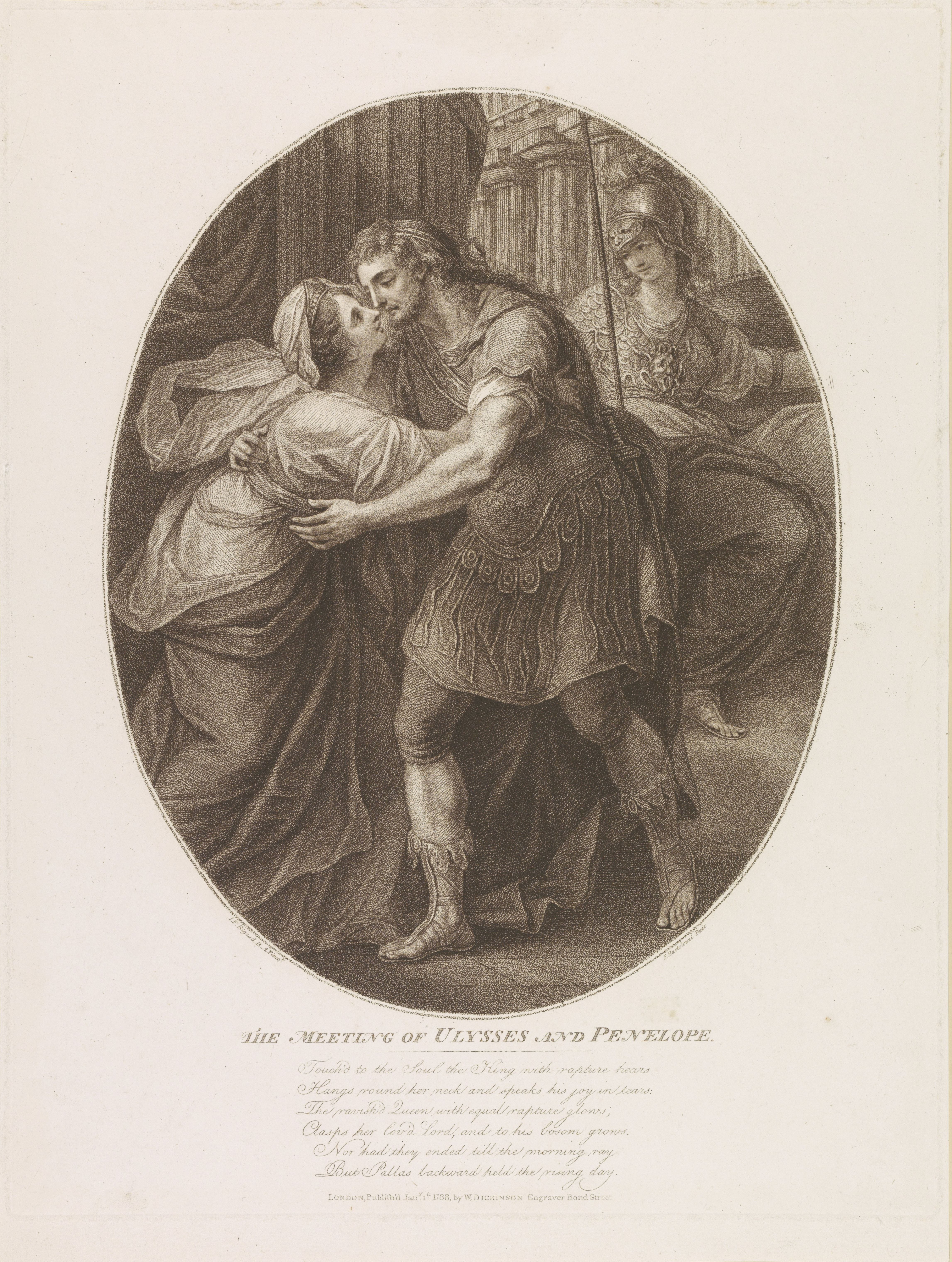
[Penelope says]
That’s our secret sign;
No man else has seen.
Now my stiff heart knows
I am yours, your queen.
And I can’t end this any better than with Robert Fitzgerald:
                                                  he wept at last,
his dear wife, clear and faithful, in his arms
longed for
        as the sunwarmed earth is longed for by a swimmer
spent in rough water where his ship went down
under Poseidon’s blows, gale winds and tons of sea.
Few men can keep alive through a big surf
to crawl, clotted with brine, on kindly beaches
in joy, in joy, knowing the abyss behind:
and so she too rejoiced, her gaze upon her husband,
her white arms round him pressed as though forever.
Translated by Robert Fitzgerald
And Athena slows the night down, to give them time together, before he and the other three leave armed, at dawn, for the countryside.
Secret signs.