
Rustius Barbarian
Baker of Bread

There is a place in a desert area of Egypt1 that has preserved writings on the poor-man’s paper — pottery shards. Pottery breaks and cannot always be repaired. Paper or papyrus must be manufactured and bought. Broken pottery that cannot be repaired is good only to be thrown away. Unless you can write on it.
One such pottery shard, dated to sometime between AD 1 and AD 199, was from a man named Rustius Barbarus, a baker, to a man named Pompeius.
Myos Hormos was the northern most major port on western shore of the Red sea during when Rustius Barbarus wrote. It supported a brisk trade between Egypt, India and East Africa. Not surprisingly, there was a Roman garrison at Myos Hormos. This garrison provided for 50-100 Roman soldiers [not necessarily citizens; possibly auxillia] and in the civilian community, there were warehouses, shops, and … a bakery.
According to https://papyri.info/ddbdp/c.ep.lat;;73 the subjects of the pottery shard are:
“private letter; from Rustius Barbarus to Pompeius; exchange of letters and merchandise; upcoming marriage” [my translation from the German2]
To my brother, Pompey.
This shard is being kept with the recipient, in the settlement in that desert area of Egypt. It’s something like a bill of lading. Pompey isn’t actually his brother. We know this because another bill of lading refers to him as being as close as a twin brother born from the same womb. A friend, not a brother, but as close as a brother. Someone he addresses as a brother.
Did you get the bread? Why haven’t you written back to let me know?
Then follows a list of recipients and quantities.
The names are in Latinized, but only Popilius has a Roman gens, and he, just like Rustius, could be a freedman, or a freeborn man descended from a freedman. The name Dutupori looks Celtic (Gaulish or British), and both Draco and Thiadices are Greek. Since Thiadices is specifically named as a cavalryman, he might be from the Greek East, Thrace, or Syria.
Rustius Barbaras is certainly foreign. What native Roman would call himself “Barbarian”? It’s not a Roman name or clan or family — it’s the Latin word for someone who is not Roman. And if Rustius is spelling the Latin the way it sounds to him, he clearly speaks with an accent. He can’t help pronouncing tam as tan and habemas as habimas.
So after the list of bread deliveries, he asks Pompey to get something for him: beautiful weights. He proposes payment in kind — baking bread — or in coin [copper]. The payment is not necessarily cheap, but also not overly expensive.
And then, at the end, two lines about getting married, of all things. And he uses the term for marriage, “Uxorem ducere,” connected with conubium.
Why bring it up? Because he won’t be coming down, presumably to pick up the weights, or maybe to get payment for the bread, until after he’s married.
Rustius Barbarus is clearly not a native Roman, but he is planning a marriage that sounds like conubium. Most likely, he is either a foreign vendor to the Roman military, or attached to a Roman auxiliary as a frumentarius. In either case, my assumption is that he’s probably using the term uxor because that’s what the Roman soldiers use for the women they make their families with, whether it’s technically allowed or not.
The only hint I see that he has Roman citizenship is using the term “uxorem ducere.” Since we have records of Roman soldiers who seemed to think they were married until a matter of inheritance or divorce came up, and since all the other evidence in this particular letter implies a man who is not a Roman citizen, I can’t be sure.
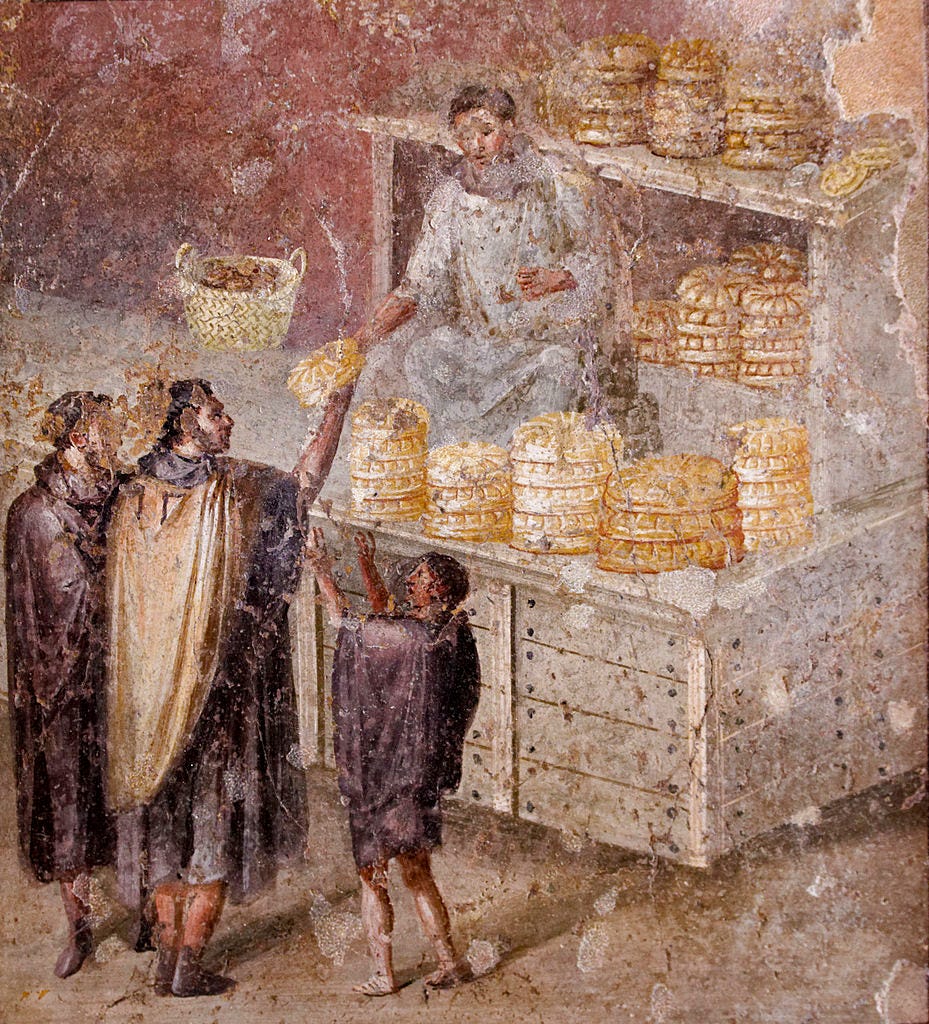
In Pompeii, Italy, there was once a baker.3 I don’t assume there is any relevance to the man addressed, whose name is Pompeius, but I could use it in writing fiction.
We don’t know this baker’s name, but we know he supported Aulus Rustius Verus for the office of aedile, the Roman magistrate in charge of public works, games, buildings, and roads. And we know that in AD 79, in Pompeii, two women and a 3-4 year old child died sheltering in his bakery when the volcano erupted.
The article mentions that the baker could have been a freedman of that Aulus Rustius Verus. If so, the freedman Aulus Rustius Verus would be called Aulus Rustius, with his third name being what he was called when he was a slave.
If I made Rustius a freed slave of the Aulus Rustius Verus of Pompey, his full name would be Aulus Rustius Barbarus. And the name “Barbarus” would have been the kind of name a slave might have been given, since it is a Latin word meaning “barbarian” or “foreigner,” from the Greek.
There are consistent misspellings of some words, which seem to imply a non-standard pronunciation of the Latin — another clue that Rustius is indeed of non-Roman birth or upbringing.
And was he supplying the garrison at Myos Hormos? Or one of the twelve way stations, manned by Roman soldiers?
Here is the translation I found in the book “The Roman Army, 31 BC — AD 337” by Brian Campbell, which I own:
Rustius Barbarus to his brother Pompeius, greetings. Why it that you have not written back to me if you received the loaves of bread? I sent you 15 loaves with Popilius and Dutuporis, then fifteen more and a vase (?) with the carter Draco; you have used up four matia (on third of an artabe) of wheat. I sent you six loaves with the cavalryman Thiadices, who said he could take them. I request, brother, that you have some scales (?) made for my personal use, as beautiful as possible, and write to me so that in payment for them I can make you bread or send you money, whichever you wish. Now, I want you to know that I am going to get married. As soon as I have married, I shall write to you at once to come. Farewell. Regards to [___].
Transcription of the Latin from the shard, of the letter he wrote4.
In Wâdi Fawâkhir, alo ng a road between the town of Koptos on the Nile and Quseir on the Red Sea. Quseir was known as Myos Hormos, during the Roman era.
https://papyri.info/ddbdp/c.ep.lat;;73
Brief (privat); Rustius Barbarus an Pompeius; Austausch von Briefen und Waren; bevorstehende Heirat
https://www.iflscience.com/ancient-roman-political-slogans-and-a-final-sacrifice-found-in-pompeii-house-70915
https://papyri.info/ddbdp/c.ep.lat;;73
Cleaned up a little. You can see the exact transcription at the link:
Rustius Barbarus Pompeio fratri salutem ·
quid est quod mi non rescripsisti si panes percepisti misi tibi ·
per Popilium et Dutuporim · panes · XV ·
item per Draconem · hamaxitem · panes · XV ·
et vasum explesti  · IIII ·matia
misi tibi per Theadicem equitem panes · VI
quod dixit se posse tollere
rogo te frater ut facias mi in ṃeos usus pondera quam formosa et scribe mihi ut pretium
eorum quid vis · panem tibi faciam aut aes tibi mittam ·
scito enim me uxorem ducere ·
quam mox duxero continuo tibi scribam ut venias · vale
saluta Sertoṛium
Hmm. And I'm having the father of "Terry" from "Loghead's Daughter" be part of the intelligence operation. I've been trying to base the world that Kolibri visits as Finance officer on the Alexandria to Karanis to Myos Hornos area in Roman Egypt. And yes, reading the shards makes me think a lot of modern logistics stuff.
Love this, Ms. Mary. So much to unpack. Apparently, the Roman era used "bro" a lot like our modern times.
"Bro, I need my share of the beer from last week's beer run. Send it with Dave from Supply, and remind him not to drink any until he reaches the post." 😁
And, if Rustius is a Frumentarius, I wonder if he's tied to the empire's spy apparatus, like many of the Frumentarii were? 🤔 The protagonist of David Drake's "Birds of Prey" was a frumentarius, IIRC.