

Odysseus comes to the dwelling of Eumaios, the swineherd Athena sent him to in Book XIII, who is completely loyal to him, Penelope, and Telemachus.
O my Swineherd
Fitzgerald does something interesting in his translation here. Looking at the Greek, Eumaios is almost always referred to as “Eumaios, the swineherd.” It is quite common in Homer to refer to important characters with set formulas, which seem to be chosen as needed to make a line of the poem scan. Athena is “the grey-eyed goddess”, Poseidon is “the god of earthquake”, Zeus is “the storm king” (among several other set formulas for all of them). Odysseus himself seems to have as many, if not more, set formulas as the gods. He is a “man of ranging mind,” “raider of cities,” “son of Laertes and the gods of old.” Here, Fitzgerald turns “Eumaios, the swineherd” into a similar set formula, referring to him as “O my swineherd!” Eumaios. Has this been used for anyone else of such low status?
Although Eumaios is a slave, he appears to have a pretty decent house, which he built himself, without informing Penelope or Laertes. Later, we will also be told he used his own property to buy a slave of his own, Mesaulios, to help with the house and yard, again without the help of Penelope and Laertes. The terms used seem to imply, not that he is doing anything improper for a slave with his responsibilities, but that he stays away from the palace as much as he can because he detests the suitors so much.
This would be something that would make sense to my first century Romans. Even though a Roman slave could not legally own anything, slaves were often authorized to purchase for their masters, and even sometimes given charge over some amount of property, including other slaves. However, the Roman slave never legally owned anything, no matter what his master might allow. I wonder whether Greek slaves were thought to legally own some things? Or whether it was an undefined gray area. The Romans certainly seemed to define more things in law than the Greeks.
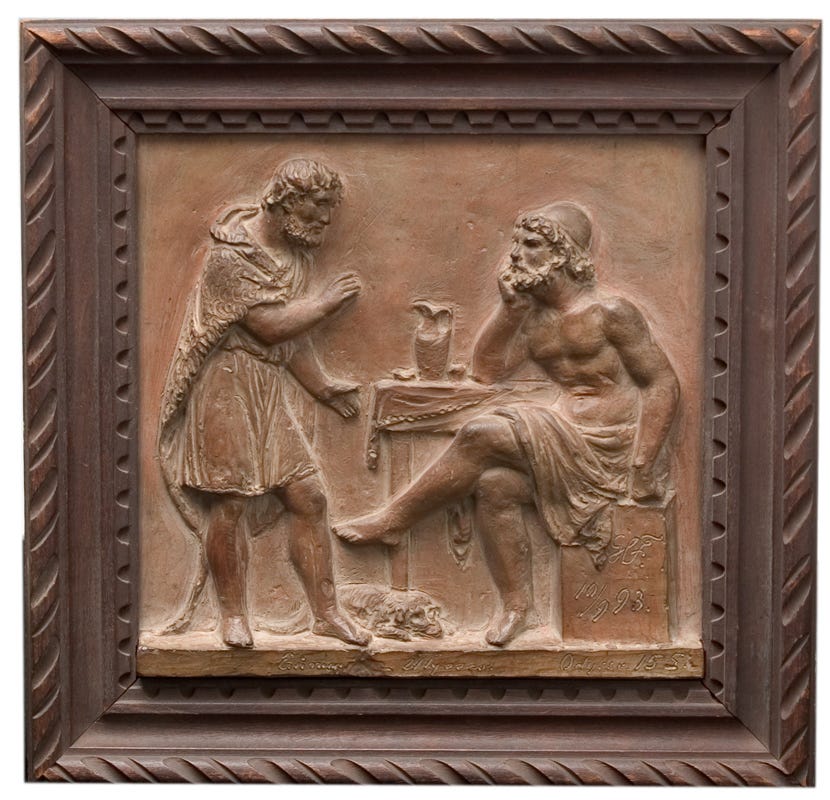
Wife, Concubine and Contubernales
Another interesting point is that Eumaios claims that the master, whom he loves, would have given him a place of his own, and acreage, and a wife [γυναῖκα] who had many suitors [πολυμνήστην: πολυ (much) + μνήστην (form of “to woo”, from which the noun “suitor” [μνηστήρ] is derived) of her own. The term γυναῖκα seems to be used interchangeably as “woman” and “wife”, just as “femme” is used in modern French or “Frau” is used in modern German. My first century Romans, though, would see such a relationship as clearly one of contubernales: socially treated as a marriage by the forbearance of the master, but with no legal rights whatsoever.
Then Odysseus makes up a story about being the son of a rich Cretan named Kastor Hylax by a concubine he had bought. It’s the first time I remember seeing the Greek word for concubine [παλλακίς] in the Iliad or the Odyssey. He is treated as well as a true son, but he is still illegitimate. His other sons are the children of ἀλόχου: translated as “a lawful wife” by Murray and as “his true lady” by Fitzgerald.
Later, when Kastor dies, his legitimate sons don’t leave his concubine’s son much, but through his own abilities / valor he still manages to get a wife [γυναῖκα] from a rich father. It makes sense that he refers to her as γυναῖκα, since as a concubine’s son he is of lower status than a legitimate son, although not as low status as the slave, Eumaios.
Later, after getting rich from raiding, and then making a name for himself at Troy, he takes a month off to enjoy his wife and children and possessions. Homer no longer uses γυναῖκα here but κουριδίῃ τ᾽ ἀλόχῳ. Κουριδίῃ means “wedded” and we also have what looks like an upgrade to ἀλόχῳ. Both translators use “wife”, but Murray specifically uses “wedded wife.” Fitzgerald makes no distinction.
Homesickness
When Eumaios describes wishing he could see his mother and father again, and the land of his birth, but that even so, he would rather see the return of his master, Odysseus even more, it reminds me of “Til We Have Faces” by C. S. Lewis. Queen Orual has had a Greek slave as her tutor since girlhood, and at one point he has the ability to choose to go back to Greece, which he has never stopped being homesick for, or to stay and continue to be her counsellor. I wonder if Eumaios will have a similar option, and if so, what he will choose.
Clothing
Once again, we get a clear idea of how expensive clothing is. Eumaios, despite being a “well-to-do” slave, in charge of four other swineherds, with a decent place to live, and a slave of his own to help around the property, still has only one spare change of clothes, and he notes that this is usual with slaves. He’s explaining why, although he can lend his beggar guest a cloak to sleep under for the night, he can’t let him keep it the next morning.
From the Bible: Exodus 22:26-27 English Standard Version 2025 (ESV)
If ever you take your neighbor’s cloak in pledge, you shall return it to him before the sun goes down, for that is his only covering, and it is his cloak for his body; in what else shall he sleep? And if he cries to me, I will hear, for I am compassionate.
There’s a reason noblewomen are always spinning, weaving, and giving clothes as part of expensive gifts. Note that the clothes aren’t usually even called “new.” In every case I remember in the Odyssey, they are called “clean” or “laundered.” I seem to remember one place in the Iliad where someone refers to a garment that has never been worn before.
That’s part of why spinning and weaving is an important part of Cloak and Stola. As here with Eumaios, both of them have only one spare change of clothing.
We were just reading GA Henty, the story about William the Conquerer. In it the English king that William conquered had had a 'wife' that seemed to fit somewhat in this vein. He had lived with her, and loved her, but she did not have the same legal right as a wife... so when he had to form an alliance with the north, he was allowed to merely send her away and marry the sister of some northern lords.